Thursday, April 26, 2012

Horse of a Thousand Wishes


Horse of a Thousand Wishes


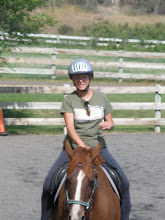
In the summer of after my stroke, I learned that there was a therapeutic riding center in Winthrop, Moccasin Lake Ranch.  There, Ginger, a barrel chested, gentle chestnut mare and I were introduced.


During my first ride, Annie, the instructor, walked Ginger and me along the trails and dirt roads behind the center. Previously, I had been told by one of my therapists that after sustaining a disability such as I had, to seek out new physical activities rather trying to return to favorite ones enjoyed before the stroke; that it would be less frustrating and more enjoyable.  After my day with Ginger, I felt, I had found one.  A new dream had come true. 
Happy Trails to You!


Back in Kirkland I continued to pursue riding at another therapeutic riding center nearby, Little Bit.  My new dream was developing! After 3 lessons, Little Bit called and reported that my bone density numbers on my left hip were too low and that I shouldn’t ride.  The reason they are so low is because I put very little weight on my left leg as I walk due to my stroke and osteoporosis runs in my family. My dream began cloud over. The Little Bit Riding Supervisor and I spoke for a long time. She did say that I could ride if I signed a liability release. Unnecessarily, she explained that any horse can spook, jump sidewise, or buck causing a fall that could perhaps fracture my hip.  This was obvious.  My love for adventure and physical activity was tempting me to sign it, but then I began to think.  If I injured myself, I would not only impact me but I would also impact my loving husband as well, maybe even more.  This seemed so selfish as he has done so much for me.  So after a time I decided to let go of the dream of riding at Little Bit. 


Given my osteoporosis, it stands to reason that I would give up riding at Moccasin Lake Ranch but I haven’t.  Pondering this for so long has not revealed a satisfying rationale. Subconsciously I must have recognized  significant differences between Moccasin Lake Ranch and Little Bit. Little Bit serves numerous children and adults and most lessons are conducted in groups of 8-10.  There is very little individual attention and I ride a different horse every time.  At Moccasin Lake Ranch I ride Ginger only, a very reliable, comfortable horse.  While in the arena, Annie is always with and there are no other horses.  It is a much smaller program. I am more comfortable and confident at Moccasin Lake Ranch than at Little Bit.


In today’s early morning dream, I was visited by The Horse of Thousand Wishes. As dawn’s early morning mist rose, from the hills and vales of the landscape, an empty, almost desolate camp was revealed. No sounds of active campers, eager to mount their ponies.  No comfortable nickering among the equine friends huddled together in the paddock.

Sweet Ginger, usually saddled, tacked and ready for me, was not there.  Neither was Annie.  There instead was Safire, the Arabian, the one I rode at Little Bit with her fast, erratic, bouncing, uncomfortable trot.  Was she for me? Was I to ride her?  Most campers did not as she is an erratic, uncomfortable mount.  Excitement and trepidation flooded me.  Should I get on?  The stable hand saying nothing, beckoned me to the mounting ramp. Ready to help. Could I ride her?  Should I rider her? My adventuresome spirit urged me to squeeze my right leg on her side.  Her spirited walk startled me, unlike Ginger’s mild plodding.  Should I be doing this?  Sure! Kick her into a trot!  No, into a canter!!  Yes!  I’ve dreamed of getting this far for so long!  But wait.  “Bone density”, “any horse can spook”.  “Do you want to risk a broken hip?”

I woke up.  Hip?  Still  in good shape.  Phew!

The wee hours during which Sapphire visited my dream today have often been occupied by dreams of wishes; running, waving to a friend with my left arm, walking barefoot, holding a baby; the return of simple pleasures really.  But when I awaken, these dreams canter away on the back on the Horse of a Thousand Wishes.


Watch the trailer!


Monday, April 9, 2012

Not Your Mother's Botox!


We all know about the cosmetic uses of botox; used to release the lines on our face that are the imprint of our lives. When I tell me friends that I am going for a botox treatment they inevitably raise their eyebrows in surprise, knowing my feelings about it. I reassure them by explaining that I use it to treat parts of my body affected by the stroke; that this is not your mothers’ bottom!

One of the effects of my stroke is that the damaged part of the brain causes the muscles on the left side of my body to contract so tightly that I cannot use my arm and leg very effectively, if at all. This is called tone. I cannot straighten my left arm. It always looks as if I am about to give someone a hard left hook. My quadricep muscles in my thigh are so contracted I cannot bend my knee. So in order for me to walk I have to swing my left leg way out to the side to clear the floor. My big toe is so contracted it curls under my foot when I walk; causing repeated ingrown toenails and intense pain which frequently forces me into my wheelchair.

Right after my stroke I started seeing a physiatrist who administers botox in stroke survivors. The botox is injected into the effected muscles and relaxes them. Wonderful. We tried it on my arm and it while my arm was no longer in it’s threatening left hook position, I still had no use of it due to the severity of the damage caused by the stroke. Since my leg and foot were my biggest complaint we tried injecting it there. This was problematic. The muscles of my leg and foot are far larger than those in the arm would require a much larger amount of botox to be effective than is recommended. So for the next 4 years I had to endure a excruciating pain in my foot & toe until I broke my knee. Huh? How does that make sense?

While in the hospital recovering from my break I spoke with my rehab doctor, Dr. Lim about the severe pain I have in my leg and foot. He explained that in his training he has learned that much more botox can be used to treat severe tone than had been thought previously. Once I left the hospital and was well on my way to a full recovery I made an appointment for botox treatment in leg, foot and arm. From 3-4pm on a Friday was an extremely long hour as I endured 17 injections! Many were pretty easy to take, others marginal and at least three made me scream out. During the last one in the outside of my left calf, the muscle spasmed so hard it bent the needle. That was the worst!


Two days later my arm was relaxed almost to the point of looking normal by my side, I could bend my knee more easily, making my walking gait more normal. But best of all my big toe is relaxed to the point where it no longer hurts! It has been 5 years that I have walked with severe pain daily. The imprint of the relief and joy show in the smile lines of my face. Those lines I am happy to show to the world!


Saturday, April 7, 2012

The Lokopad @ Pushing Boundaries

The Lokomat at Pushing Boundaries

In July of 2011 I started going to a gym called Pushing Boundaries. This is a gym specifically for people with physical disabilities. The range of disabilities served include paraplegics, quadriplegics, stroke & multiple sclerosis. Pushing Boundaries has an incredible machine called lokomat. It is a glorified treadmill. The purpose of its use depends on the individual’s disability. For hemiplegics and paraplegics the benefits include increased blood circulation and bone density. For stroke survivors it works on neuro-muscular re-education and improvement of the walking gait. This is why I go there. There is a YouTube video of me on it. Its URL is below. The following explanation of how it works will make the most sense after viewing the video.


Watch a video of me on the lokopad. Paste the link below into the URL box.

http://www.youtube.com/watch?v=cJezeEytxV0&context=C4cdb61dADvjVQa1PpcFMlR_vybtBEK06e5R1M3io9Bd814SApls8=


The therapist puts me in a very tight harness that goes around the abdomen. It is so tight I now think I know what a corset must have been like for women in the past! Once on the lokomat I am suspended by an overhead lift. I call it my Baron Harkonen moment. While suspended the therapist attaches robotic arms to my legs, starts the treadmill and slowly lowers me onto it while the robotic arms move my legs in the proper mechanics of the walking gait. Simple enough but this where the work for me begins. In front of me are 2 screens with moving line graphs displayed on them. One screen monitors the left leg, the other the right. Each screen has 2 lines a white one and a red one. The white line monitors the front muscles, the red, the back. The lines on the graph indicate how much effort I am exerting in each muscle group. We start with one muscle group in my non-effected or strong leg. I set a baseline on the graph using that muscle for 30 seconds, then we switch to the weak leg and work that same muscle group trying to meet the baseline set by the strong leg, very hard to do! The therapist coaches me on timing of the activation of my muscles because if I activate them to soon or too late in the gait the muscle isn’t effective and I walk incorrectly. After 30 seconds we switch to another muscle involved in gait. We usually do 2 rounds of this followed by other less specific walking work. After this we remove the harness and I can breathe again! Then we move to the weight room and work on these specific muscle groups again with weights. We also walk to try to integrate the work on the lokopad into my unassisted walking gait.

I am now 5 years out from my stroke. Of all the therapies I continue to do, the work at on the lokomat is the most powerful in developing strength and correcting my gait. My gait is still not correct but I keep working at it. I was told in the hospital that whatever gains I make in improvement will come in the 1st 2 years after my stroke. Well after 5 years I am still making progress, albeit slow progress. I believe the brain is an incredibly plastic organ and that there will always be improvement. This is why my other part time job continues to be therapy!


Tuesday, November 30, 2010

Greatest Birthday Present Ever!

My Birthday, November 25 this year, happened to fall on Turkey Day. Yipee! That gave me a 4 day weekend in which to celebrate. I received the gifts of good food, good friends, warmth of body, love of family and laughter. I also received the best gift ever; being able to help a family in crisis.

Since my stroke, I have become a peer mentor at the hospital where I survived and began recovering from my stroke. As a peer mentor I go to the hospital and visit with stroke survivors and their families who are about to go home. Going home after suddenly becoming disabled, physically or mentally or sometimes both, is daunting beyond imagining for the survivor and the family. On Saturday of the T-Day holiday weekend I was called to visit a 46 year old woman. I will call her Molly. She had just survived a series of left brain strokes. She has no insurance, therefore, she was unable to take advantage of the in-patient physical & occupational therapy at the hospital. Her family has meager means, thus, her prospects for a robust recovery are slim. Her social worker was able to get her into a "nursing" home for 2 weeks to do some physical & occupational therapy before going home. Molly was refusing to go to the home. When I got to her room her adult daughter was outside the door sobbing, inside the husband was too. They were so frustrated because they correctly saw this as Molly's one chance for therapy. I recognized that she was terrified and also knew that the sooner she engaged in therapy the better were her chances of recovering lost function. After gaining her trust I asked her about her fears. I listened and listened. When she was finally spent I explained the value of this therapeutic opportunity over and over until finally she agreed to go, for "1 week". Hopefully once she's been there for "1 week" she will realize the value of staying for 2. I will never know. But, I do know that the hug of her daughter gave me as I left was topped only by her smile.


P.S. Soon after my return home I read an article out of Stroke Connection Magazine the articles of which are all written by stroke survivors. In this article the author was explaining what was good about his stroke. I couldn't believe it!!! I tossed the magazine. I get it now. If I had not survived my stroke. I would not have been able to help this family.

Wednesday, August 25, 2010

My Greatest Fear

  Just received a text from a fellow Stoke Survivor.  She was in Swedish Hospital for a broken knee AND a hemorrhagic  stroke - the same kind I suffered.  I do not know the extent of her brain damage yet.  Since the survival rate for this type of stroke is only 15% she is considered lucky. If her cognitive function is still good and she doesn't have aphasia - inability to speak intelligibly she in fact is lucky.  She's lucky since the absence of those two afflictions means she can still participate in life.  It is curious to me that when a person survives the tragedy of stroke most people automaticaly assume the victim is 'lucky'. After my stroke I wanted to die.  I couldn't walk or use my left arm. My husband continued to remind me how lucky I was.  That infuriated me! How could I be lucky with these disabilities? I did not understand that I could have lost my cognition, sight, ability to read or speak, all common afflictions of stroke. These abilities are central to being able to participate in community. Even if I can't ski or run or do any myriad of physical pursuits, I can teach children, talk with my husband, laugh at funny situations, etc. If we don't have those abilities we are truly alone.  Greatest Fear!!

Tuesday, August 24, 2010

A New Life of Solving Problems


Once I was moved from the Critical Care Unit to the Acute Rehab Unit, my new life of solving everyday problems began in earnest.
That first morning my occupational therapist, whose job it was to help me with activities of daily living (ADL), helped me transfer to a wheelchair,wheeled me to the sink so I could brush my teeth for the first time in a week! Simple ADL right?, Wrong! One must remember that the stroke rendered my left arm completely useless. My elbow is permanently positioned in a 90 degree angle and and my fingers are constantly clenched in a tight fist. So how does one unscrew the top off of a tube of toothpaste? How does one stabilize the tooth brush so the paste goes on the brush, not the counter? Argh!! So frustrating!!! Sometimes, depending on the task, I recruit my teeth to help out, but I have to take care not to abuse those! I certainly would miss those if I lost them. Life is full of innumerable, seemingly simple tasks such as this and a stroke survivor as to muster up an unfathomable amount of patience to successfully solve them without blowing a gasket. 

The most intensely aggravating of these ADL's is the bra!! Who invented these anyway? Gosh I yearn for those days before children and age made wearing a bra unnecessary! I know I am bordering on TMI. Oh well. Initially my solution was to hook the back closure of the bra together and pull it on over my head; not easy either but after many attempts of getting hopelessly tangle in it, I figured it out. The draw back to this technique is that it did not take long for the bra to get hopelessly stretched out as to render it ineffective. Why bother? My husband suggested that I try one with a front closure. Well those clasps require 2 hands and manual dexterity. With only one functional hand, that was out of the question. After several months I finally took my bra to to a tailor. I described to her that I wanted her to cut the bra between the 2 cups and sew in place two opposite strips of Velcro. It worked, problem solved! 

I have a dear friend who wanted to appreciate just how daunting ADL"s can be for a stroke survivor whose arm is paralyzed. So she restricted the movement of her arm for 24 hours. She kept a journal of her experience. She was struck by just how many ADL's there are that are incredibly difficult to do with only one hand. The task the presented her with the most challenge and frustration? Putting on a bra! I felt validated!

Saturday, August 7, 2010

What about Sex!

Well, It has been quite some time since I posted on my blog.  Life got in the way!!  Yesterday I found myself thinking bout the various questions I've been asked about my stroke and subsequent disabilities.  I am quite open to answering these questions and welcome them. However, I have been presented with a question for which I was not prepared! When I visited my school and  students 3 months after my stroke, a teacher with whom I am collegially familiar but not, shall I say, "close"to  came bounding up to me and in a hushed tone inquired, "How do you have sex?"  Being taken aback, and unsure of  what to say, I said, frankly, "The same way most people do".   To this day I am not really sure what it was she was looking for.  Knowing that the left side of my body was left paralyzed and my sensation of touch was also severely compromised by the stroke,  did she want to know about sexual positions, libido, sexual response, whether mechanical aides are necessary/beneficial? .....I can only wonder.  

 I have pondered this question over the ensuing months/years .  Any reading material I stumbled into that addressed sex  said basically the same thing without exception including:
  * Make sure you  (stroke survivor) maintain good personal hygiene.  This can be a challenge for anyone with disabilites.
  *Intimacy can  be attained without climax.
  * Do only what you're comfortable doing.

While these are important "tips" for anyone engaged in a sexual relationship, I felt all of these articles fell short in addressing  the issues that come up in  a sexual relationship for people with physical disabilities.

If my colleague were to ask me this question today, I would address these points:

If the pre-stroke preferred positions for sex are no longer possible or safe work together to discover new ones.

If the sensory perception is so compromised  a mechanical aide might be helpful in achieving satisfaction.  Try one or two or three, you never know which one will be best. 

I was told by my acupuncturist that the libido meridian is located in the foot. She explained that lightly trailing a soft feather over the feet and the rest of the body during foreplay stimulates the libido.  That worked for me!

When stroke strikes the survivor  and their partner begin a marathon journey of problem solving.  Very little of daily life is conducted the same way.  Partners have to figure out how to do things differently.  The same goes for sex.  Since there are 2 people involved in a sexual relationship, open, honest, kind and patient communication is critical for mutual satisfaction and intimacy to occur.  If the partners had these qualities  of communication in their relationship before the stroke and sex was mutually fulfilling, then mutually satisfying and intimate sexual encounters can continue after the stroke. Both partners simply have to approach sex differently!

Saturday, November 28, 2009

The Wheelchair War Days

I debated whether to title this post The 7 Stages of Grief because the Wheelchair Wars were an outgrowth of  my grieving.  To lose so much of one's physical function is so consummately devastating that grieving must be done. As I went through the stages of the grieving process I recognized many of them from previous readings I had done on death of a loved one. Below,  I took the liberty of changing words about death and  loss of a loved one and replacing them with words fitting to my loss of physical function.

7 Stages of Grief...

1. SHOCK & DENIAL-
You will probably react to learning of the loss with numbed disbelief. You may deny the reality of the loss at some level, in order to avoid the pain. Shock provides emotional protection from being overwhelmed all at once. This may last for weeks.

In the CCU my first brush with denial was when I asked my neurologist if I would ever regain my physical functions I'd lost.  He said it is different for everyone, but what I do regain   will  come within the first 2 years .  Well, I said to myself, "Not so, I will get it all back before that! Permanent disability is NOT going to be me!""  I hung onto that denial for months before I yielded to reality.  I do believe, however, that as long as I keep working at my physical therapy, my brain will continue to heal and I will continue to make incredibly slow progress over the rest of my life.  I have to believe this.  The alternative is grim.   Perhaps this is still denial, I don't know.  Guess the future will show me.


2. PAIN & GUILT-
As the shock wears off, it is replaced with the suffering of unbelievable pain. Although excruciating and almost unbearable, it is important that you experience the pain fully, and not hide it, avoid it or escape from it with alcohol or drugs.


Relentless tears marked these days, punctuated with what I call my "never" statements:  "I'll never do this again, or that again."  While there are somethings I will probably never do again. I've learned I can relearn to do many things again, albeit, differently from before and I also can learn to do and enjoy new things I never did before because they weren't of primary interest to me.

3. ANGER & BARGAINING-
Frustration gives way to anger, and you may lash out and lay unwarranted blame for the death/loss on someone else. Please try to control this, as permanent damage to your relationships may result. This is a time for the release of bottled up emotion.

You may rail against fate, questioning "Why me?" You may also try to bargain in vain with the powers that be for a way out of your despair ("I will never drink again if you just bring him/function back")
 

During this stage I inflicted damage to the walls and door jams of our house by slamming the wheelchair back and forth, especially when I got stuck while navigating around corners and hallways.  These fits of rage were always followed by a torrent of angry tears and pathetic wailing grief.  I screamed the questions, "Why me?"  This is not fair!  I did all the right things, ate right was the strongest and most fit I'd ever been in my life!  Why not someone else who smokes and is over weight and out of shape?"  These fits were very difficult for Pete to witness for he was powerless to do anything to alleviate my despair.  Finally, he said while I resumed destroying the walls.  "You can keep doing this but it will change nothing.  When you're finished you'll be right back here with the same problems And you'll feel  guilty when you see the damage you're doing to the walls. " He was right and gradually the frequency of these fits lessened as I began to move on.


4. "DEPRESSION", REFLECTION, LONELINESS-
Just when your friends may think you should be getting on with your life, a long period of sad reflection will likely overtake you. This is a normal stage of grief, so do not be "talked out of it" by well-meaning outsiders. Encouragement from others is not helpful to you during this stage of grieving.

During this time, you finally realize the true magnitude of your loss, and it depresses you. You may isolate yourself on purpose, reflect on things you did before your loss, and focus on memories of the past. You may sense feelings of emptiness or despair. 

I felt all of this and still do at times.  I was taking an antidepressant before my stroke and the doctor had upped the milligrams to keep this inevitable depression at a manageable level....Better life through Chemistry?  Rather than isolate, I threw everything I could at my stroke:  Aquatic therapy, physical therapy, acupuncture, deep tissue message, counseling, and adapted pilates.  I did therapy everyday often twice a day.  Remember I was going to be all back in under 2 years.  Denial, still strong and healthy. I exhausted myself daily and slept like the dead at night.

5. THE UPWARD TURN-
As you start to adjust to life without normal function, your life becomes a little calmer and more organized.  Your "depression" begins to lift slightly.


A turning point for me was getting my driver's license back as this gave me more independence and lightened Pete's burden.  Another upturn for me was when I returned to school to teach albeit only 1 class period a day.  I now teach 3.  One of my greatest fears was that I would never be able to do anything meaningful again.  I am so glad I still can.

6. RECONSTRUCTION & WORKING THROUGH-
As you become more functional, your mind starts working again, and you will find yourself seeking realistic solutions to problems posed by life with limited physical function. You will start to work on practical and financial problems and reconstructing yourself and your life without it.


This I did.  I was balanced enough to begin tackling the logistics of negotiating my life as a disable person.  I began my quest of solutions to the many problems facing me everyday.

How to open a can or bottle of wine.
How to put on a bra.
How to chop veggies so they don't roll around
 how to open jars
How to carry a cup of coffee to my classroom from the car.
The list is endless.
With each solution came a real sense of accomplishment and increased sense of independence.  The quest for solutions continues everyday.

7. ACCEPTANCE & HOPE-
During this, the last of the seven stages in this grief model, you learn to accept and deal with the reality of your situation. Acceptance does not necessarily mean instant happiness. Given the pain and turmoil you have experienced, you can never return to the carefree, untroubled YOU that existed before this tragedy. But you will find a way forward. 

This is where I am today.  I have days when I am quite happy and content and others that are angst filled.  The thing I've noticed about the grieving process is that it is not linear.  Many of the stages revisit me in no recognizable order. I can get so angry  but I know if I indulge it I will damage something and since we are remodeling, & repairing & repainting the damage I inflicted over the past 3 years, I know that is not a constructive response to my anger.  I still cry bitter tears.  I fight depression.  But I do try to be grateful for what I  still have.  With acceptance of this "new normal" comes more peace.


The link to the 7 Stages of Grief 


The Simple Pleasures I Miss

At first glance one can easily see and appreciate how a stroke survivor would miss the obvious things such as walking normally.  While I do miss these things it is really the simple pleasures I miss most. Going barefoot, wearing flip flops, freedom of simple movement, wearing shoes other than clunky tennis shoes, slipping  on a shirt, putting lotion on my right arm after a shower, making love the way Pete & I used to, taking  a quick shower; it is always a 1/2 hour ordeal, minimum.  I could go on.  If you are at all curious about what difficulties a useless arm can cause, try taping your arm to your torso for 12 hours, that will give you a glimpse.  Of course, a useless arm is only half the puzzle.

Wednesday, November 4, 2009

Home!!!!

On April 7th I was permitted to return home.  The simple acts of getting fitted for a wheel chair and listening to all of my therapists' last instructions to me and riding in the car on the way home was exhausting.  Pete helped me into bed where the puppies promptly joined me.  I slept most of the afternoon.  When I awoke I saw Pete watching me from the door.  While looking back at him I noticed that Emma, my dog, was sleeping under my arm.  I got the sense that Aerial, Madeline's dog was nearby but I could not tell where.  I asked Pete, "Is Aerial next to my face?"  He smiled and nodded. I could not feel her, but I knew she was there.   Where the therapists  in the ARU left off, the puppies jumped right in!


  I slept until morning  when Pete woke me saying I had a meeting with the clinical coordinator from Rehab Without Walls.( RWW).   I'd been told about it while in the hospital but didn't remember  it.  RWW is just what its name implies, a rehab program that is not housed in its own building.  The rehab therapists come to the patient's home rather than the patient going to a clinic to begin the process of reclaiming  independence and function.    It makes sense really.  There is limited value in learning to transfer from a wheel chair to the toilet or shower bench, for example in the hospital when the layout of the home bathroom does not even resemble the layout of the hospital bathroom. 

 The clinical coordinator assigned me 5 therapists:  a PT(physical therapist), Colin, an OT (occupational therapist), Paul, a Rehab Specialist (RS), Dana, a Counselor, Cynthia, and a speech therapist, Erin.  I saw each of them twice a week for 2 hours at a time.

Colin  began my PT by working on basic strengthening excercises for those muscles I could move.  They were going to do double duty for for the forseeable future and needed  to be as  strong as possible.  When we began he squeezed both of my thighs and commented, to my relief, "You're going to be an ambulator."  Music to my ears! :) It gave me hope that I might one day walk again.   As time went on and I progressed I started going for short walks with my cane.  We  started with short distances like 10 feet but I quickly advanced to walking around the block, however, not with a gait you'd recognize as normal.  My OT worked with me on activities of daily living. For example: learning to transfer to/from  the shower bench safely, getting in and out of a car, tying my shoes one handed.  Never did get that down.  Viva la velcro!, grocery shopping, things like that.  Paul stretched my arm and shoulder quite a bit but as far as strengthening the arm there was  not much he could do since I could not and still cannot move my arm at all.  My speech was never effected but my ability to organize was.  This is what my speech therapist helped me with.  She helped me use a planner.  This was a challenge. This lack of organization made doing simple arithmetic calculations impossible for me, not good for my prospects of returning to work as a 7th grade math teacher! So Erin brought me tasks to perform like calculating the cost of produce on sale as advertised on various  mail circulars and figuring out the store where buying certain items was cheapest.  She brought me sudoku puzzles and newspaper articles to read.  These all helped strengthen and sharpen my mental capacities, rattled by the stroke.   She was great because she also was the first person to get me to really laugh.  She was a hoot!  My counselor wasn't all that effective.  However, deep into the summer Cynthia did  say,"I see you driving again."  Something that had never crossed my mind!  Yea, more hope!  I got my license back about mid October.  A huge step forward on the independence scale.  The Dana, my rehab specialist RS basically helped me execute the home exercise program that Colin laid out for me.  Dana was wonderful!!!!  Still is, as she is the only one who from RWW that I continue to see.

  I had RWW come to my house until mid August when my insurance would not pay for it anymore.  They were all fantastic and really jump started my recovery.

Friday, October 23, 2009

When is muscle tone not a good thing?

During one of my PT sessions while still in the ARU, Renee was having me take a few steps while I held onto the rail on my right side.  I was completely focused on holding on like a vice grips and so I didn't notice nor feel her bending my left knee behind me and then bringing it forward to place it on the floor ahead in order for me to step forward.  I only noticed it when she grunted at the effort it was requiring of her.  She stood up, out of breath and sweating, exclaiming, "Wow, your tone is so strong!"  Now, seeing as I had, for the precious year, been free-weight training  I knew that strong muscle tone was desirable and a good thing.  But I could gather from the way she said this that in my new situation this was not so.  It wasn't until several days later that I caught a glimpse of what stroke induced muscle tone was all about.

While proceeding through each day, the extreme difficulty in moving and bending my joints, on my left side, was explained to me as profound muscle weakness.  I figured over time my muscles would get stronger as I engaged in my therapy and that I would gain back full function and mobility.  I soon was to learn that muscle weakness was not the whole picture.  As my inpatient therapy continued, Renee tried to have me go up a small set of stairs.  When my left leg would not bend at all to go up to the next step I looked back at it, as if by staring at it, I could will it to bend.  It remained straight and bendable as steel.     To several those who have tried to bend my leg or elbow for me, I have asked how they would describe tone. The most apt descriptions are: "involuntary and severely strong constant contraction of muscles"and "intense rigidity of the muscles." I asked Renee, "Will this tone ever go away?"   She replied, "No, but your muscles might get strong enough over time to  overpower it."  Grim!  Conditions that  exacerbate my tone are emotional upset, being cold, fatigue and inactivity.  The tone makes me feel shackled and imprisoned.  I have fought for 2.5 years now  and continue to fight everyday to strengthen the muscles I can move.  Complicating this effort to move and strengthen my muscles is that many of the neurons that connect and "talk"to the body's peripheral nervous system were destroyed in the hemorrhage.  So when I try to move certain muscles I can't even find them in my brain to initiate the movement.   Part of my therapy includes using an electric stimulation unit which provides biofeedback to the brain, trying to reteach the brain to restablish those connections.  This is how it works.  I place electrodes on the belly of the muscle I am working on.  The stim unit is designed to send an electrical charge to the electrodes when it detects any motion in the muscle.  This electrical charge is delivered to the muscle and causes to muscle to contract thus, bending the joint.  Overtime this causes the brain to make connections blown out by the bleed. Each time I  move the muscles ever so slightly the muscle very slowly gets stronger.  It is a painstaking and very difficult, slow process.  It is hard to see any real progress.  The most effective way to get the muscles and brain to begin talking to each other again is to have the muscle in question bear weight.  This was why my first therapy task with Renee was standing.  Weight bearing sends powerful messages to the brain causing connections to be restablished faster.  This is why most stroke survivors who regain muscle function get it in their legs first rather than their arms; we don't don't bear weight on our arms & hands.

There is a positive side to my tone.  Without it my muscles would be so incredibly weak I would not be able to stand at all, much less, walk. My left leg would be a wet noodle and collapse beneath me.  The tone keeps my leg  rigid and tight which allows me to walk, albeit with an abnormal gait.

 I started being able to walk very short distances (10-15 feet)  with a cane 4 weeks post stroke. I now can walk out and about  relatively safely with my cane.  When at home and feeling strong I even toddle about caneless.  I still have tremendous trouble bending my left leg at the knee when I walk so I walk with a kind  of like a gangster wannabe -like gait, left leg mostly straight!  One of the very first things I heard about physical therapy was to NEVER stop  it.  I see now that if I stop PT ,as much as I'd sometimes like to, I will not only stop making progress, but will lose the progress I've worked so hard to achieve.  Once, while speaking with a friend on the phone I was describing my PT session earlier that day and he said, "Oh, you're still doing that?"  I replied, "I will being doing therapy for the rest of my life." 

Next post : The Joy Simple Things Bring

Nurse Ratched Really Does Exit!

Anyone who has ever spent much time in the hospital probably has a story to tell about a Nurse Ratched, of One Flew Over the Cuckoo's Nest infamy.  Here's mine. 

 After four weeks of intense daily therapy my PT, Renee announced that I had progressed enough that I  could go on an outing with my husband on Saturday afternoon provided I satisfactorily learned how to transfer to and from my wheelchair to the car during my Saturday morning PT session with the weekend therapist.   After we (therapist, Pete & I)practiced the transfers, the therapist gave me a "pass"  and I was good to goon my outing.  I had not told Pete, my husband, about the outing.  I wanted to surprise him.  I was not permitted to leave  the car on my outing for safety reasons, so my plan was to have Pete drive me to the house and bring my puppies out to the car so I could snuggle with them  I missed them so!!!  While I was practicing my transfers in the parking lot a substitute head nurse (read Nurse Ratched)  took over the evening shift.  Back in my room, as I was telling Pete about our surprise outing.  This new nurse came into my room and abruptly informed me that she was canceling my outing.  Her reason was that I was a fall risk because I had fallen out of my wheel chair twice that 1st week in the hospital. Not knowing the nature of those falls she assumed I had impulsively tried to get up and walk around and that I would  again, thus potentially  endangering myself.  She didn't want to damage her "impeccable record of  patient safety". No amount of pleading or bargaining would sway her. Once I returned to my room  I learned that she not only canceled my outing but she put me on"sitter" status.  That meant I had to have a "sitter" in my presence at all times.   I was furious!  Pete assiduously tried to change her mind, to no avail.  He even tried to get the phone number of my Neurologist so he could call and tell him to intervene. Nurse Ratched refused to give  Pete the number claiming, " Doctors don't like to be bothered with such matters."  I felt as though I were in prison.   When Pete had to go home to bed I felt completely alone and powerless.  The only thing I could control were my actions. So, I refused to eat, take my meds.  or use the toilet or speak to anyone.    The next morning nurse Ratched came in my room to convince me to urinate because it had been many, many hours since I last relieved myself .  I refused.  She left but soon returned to measure the amount of urine in my bladder.  It was quite high.  In retrospect, I was curious why I never felt the urge to go.  I guess I was so angry that nothing else could get my attention.  Nurse Ratched looked me in the eye and threatened to reinsert the catheter if I refused to use the toilet.  I yielded.  To add insult to injury  the sitter was required to be in my presence even while I peed.  How humiliating!!!  I sobbed and sobbed and continued my belligerence in not cooperating.  The following Monday morning my neurologist on his rounds came to see me.  Having heard all the details of what transpired over the weekend from the floor nurses who witnessed it all, he was very apologetic, saying Nurse Ratched should have called him.  He would have rescinded her oder to cancel my outing and removed the sitter. Perhaps that was precisely why she did not give Pete his number. She was all about power. My neurologist informed me that she had violated my patient rights protected by the hospital and that he'd file a formal complaint and have her removed from the substitute list and thus she would never work at Evergreen Hospital again. Only after hearing that did I start taking my meds. and eating again.

Saturday, October 17, 2009

Truly Hard Workouts With the Power to Terrify

On day 2 in the ARU Renee, my PT,  showed up as promised to begin my physical therapy.  She wheeled me down the hall and stopped at the hand rail along the wall,  where she helped me transition to a stand.  I faced the wall desperately grabbing the hand rail with my right hand, for I was certain I would crash to the ground.  I looked into Renee's eyes for reassurance as I could not fathom why I could not stand without holding onto a solid object.  She looked at me and revealed Lesson #4 "It's tough to stand on a leg you can't feel."  She then asked me to turn 90 degrees so my right side was nearest the wall. As she surveyed my body position, she reported that I was leaning way over to the right side and that she wanted me me to lean to the left to "find the middle", in other words, evenly distribute my weight between each leg. Easy enough, I thought and when I confidently thought I had found the middle, I looked to her for confirmation.  She said I was still way over to the right! For the next hour, try as I might, I could not even come close to the middle as sweat poured down my back and temples. On my way back to my room I catastrophized  in my head, "If I can't even stand, how will I ever walk again??!!"  I began to dissolve emotionally when in walked Rita, my OT, no time for grief now!

  Rita was ready to give me my first session  on an important activity of daily living: bathing.   I will spare you the intimate details.  Just remember at this point I needed help with anything and everything. While Rita was bathing me my tears were hidden by the water streaming down my face as I despaired thinking I would always need someone help me do this most private of things, bathing. In subsequent sessions I would begin to do  specific  bathing tasks on my own such as shampooing and thoroughly rinsing my hair.  On this day  it did feel great to shower as it had been over a week  since my stroke occurred. Lesson #5 Personal hygiene is more important than ever  because it requires so much effort  with only 1/2 the body helpng that it is easy to neglect.

I was longing for a nap after my shower but was instructed to eat  the meal presented
 me as my body would need every ounce of energy I could give it.  (Yum?)  No rest for the weary.

After lunch, Nancy my speech therapist (ST) came to visit.  Since my speech was not seriously impaired I wondered why I needed as speech therapist.   Cognitive function falls under the speech therapist's purview as well as speech.  I was given a diagnostic test to assess how much or what type cognitive damage might have occurred.  The language/reading part of the test went ok but not great. However,  the mathematics/logic part resulted in panic.  I could not add 2 four  digit numbers  among other simple arithmetic problems!  This spelled doom for my career.  Terrified I would never teach again, I could hold in the tears  no more.  A cascade of fear and anger consumed me. I cried until overcome by sleep.  I don't think I smiled again for many, many days.  Lesson #6  Mental recovery from stroke can be as daunting  if not more so than the physical recovery.  Oh Joy!!

Friday, October 16, 2009

The ARU, my New Digs for the Ensuing 5 Weeks.

While being moved into my new room in the ARU (acute rehab unit)a substitute nurse was looking for some wipes to clean me up.  Being unfamiliar with the location of everything, she could not find them.  I looked around from my wheel chair trying to be helpful and spied them on a wheeled table about 2 feet from me, so I reached out to get them for her and fell right out of my wheel chair onto the floor! I Thought to myself, How ridiculous! and  thus, I received lesson#1:  I am paralyzed on the left side and have no control over my body.  The head nurse, Karen, rushed in and accusingly asked, "Where do you think you're going? "Oh I was intimidated! Lesson # 2: I need help doing anything and everything. The next day I met Renee, who I had actually met already in the CCU the day before. During my stay in the CCU I had complained so vociferously about the catheter I had which, by the way, is an invention of the devil as it made me feel like I had to pee constantly, that the CCU staff finally relented and removed it so I could pee like a "normal person."  Renee who is a physical therapist (PT) was summoned to help me transition  out of bed and onto a bedside commode.  I have to say it was a glorious pee! Nothing ever felt so good!  I totally enjoyed every second of it and did not care that there were at least 5 people in the room  watching me.  Anyway when Renee entered my room in the ARU and reintroduced herself she informed me that she was my PT for the duration and that she & I would work for an hour every morning and 1/2 four every afternoon.  She then asked me to set some long term goals for myself.  The list began with being able to cross-country ski again.  In retrospect I thought it curious that I did not first say walk again, since cross-country skiing requires being able to walk!  Under Renee's continued prodding I added to  my goals.  Walk again, teach again dance with my husband again, laugh again.  The list was pretty short and the goals seemed unattainable at the time.   Had I known then what I was to learn in the next several months about the extent my disabilities I would not have survived emotionally. I probably would not have been able to muster the courage to face and try to meet the challenges that lay ahead.   Ignorance sometimes really is bliss.   That was my 1st PT session.

 In the afternoon I met Rita my occupational therapist(OT) whose job it was to help me learn to do activities of daily living. (ADL)   First, she had me sit on the bed with my legs hanging over the edge without falling over to either side.  Piece of cake I thought to myself.  It was until she asked me to lean to each side maybe 6-10 inches.  I fell over every time I tried to both sides. Rita had to right me each time as I could not do it  myself  So my 1st OT appointment was trying to lean side to side in a sitting position without falling over.  Lesson #3 I am weaker than  I could have ever imagined. I had OT 1 hour every morning and 1/2 hour ever afternoon.  For the first few days in the ARU I only saw Renee and Rita which was enough for the time being.  Later I met my speech therapist(ST).  Most of you probably can surmise that I was not a stranger to physical work out given my past.  However, the workouts I was used to  were incomparable to those that were to come.  Next post will  give you a glimpse as to what really hard work is.

Tuesday, October 13, 2009

The night of February 23, 2007


I had just finished watching a movie with Madeline.  So I got up, grabbed the phone and flopped on the bed to talk with Pete who was on his way home from a week-long business trip.  While talking Pete said," Honey, I can't understand you.  " 
 I replied, " I am having trouble enunciating my words and you know what?  I also can't get off the bed."
     "What do you mean You can't get off the bed? "
     "I am lying on my tummy and can't push myself up. "  Sensing something was really wrong, I whimpered,"When are you going to be home?"  
     "I'm just getting off the freeway."  I hung up  and I thought to myself, perhaps if I slide to the floor I will be able to get up by pushing myself up off the firmer surface.  Once on the floor I knew I was stuck until Pete got home which was about 5 minutes later. I was unable to  move! I called for Madeline who, back in her room could not hear me. So I waited.  When Pete got home, he called for me but I couldn't answer as I was barely conscious. Searching from our bathroom past the bed and into the hall he couldn't find me because he did  not know to look on the floor between the wall and the bed.  He called for Madeline who did not know where I was either.  She began to search for me as well.   After they found and sat me up  Madeline took one look at my face  and exclaimed,"Daddy, what's wrong with Mommy's face?"
     "Oh my God she's having a stroke!!", to which I belligerently replied, I am not having a f&*!@* stroke!  Well, I could not have been more wrong!!  In the CCU that 1st night, I was in and out of consciousness and only remember snippets of conversations.  One was "It's inoperable." Not comforting words I must say. Pete recounted to me later that at one point the OR was moving very frantically as I was slipping away. They worked hard to precipitously drop my blood pressure (BP) to slow and eventually stop the hemorrhage. I spent 7 days in the CCU where I learned that the cause of this massive deep brain hemorrage was very high blood pressure. A blood vessel simply broke under the strain.  The irony is that all of my life, doctors have commented on my low blood pressure .  The last time I'd seen the doctor prior to my stroke was the previous August.  The doctor made no comment about my BP and 6 months later I landed up in the CCU!  Go Figure!  Since my stroke I can't tell you the number of people who have exclaimed, "Of all the people I know you are the most healthy & fit and the last I'd suspect of suffering a stroke. So that leaves me with, It CAN happen to anyone at anytime.
Next post?  I will begin the story of my recovery.


Sunday, October 11, 2009

Stroke Changes a Person

A stroke changes a person.  There's no doubt about that!  So who was I before my 2/23/07 hemmoragic stroke?  Here is a thumbnail sketch:  7th grade math teacher and department chair most of whose leisure time was occupied with physical activity.  I was a gym junkie. Hitting free weights and intense cardio training 5 days/week.  I was able to bench press my body weight. I was an avid cross country skier in the winter, a hiker & mountain biker in the summer.  I was strong and loved it!  That all changed when I became left-side hemeplegic from my stroke.